Defect Identification System
Computer vision for automated manufacturing defect inspection
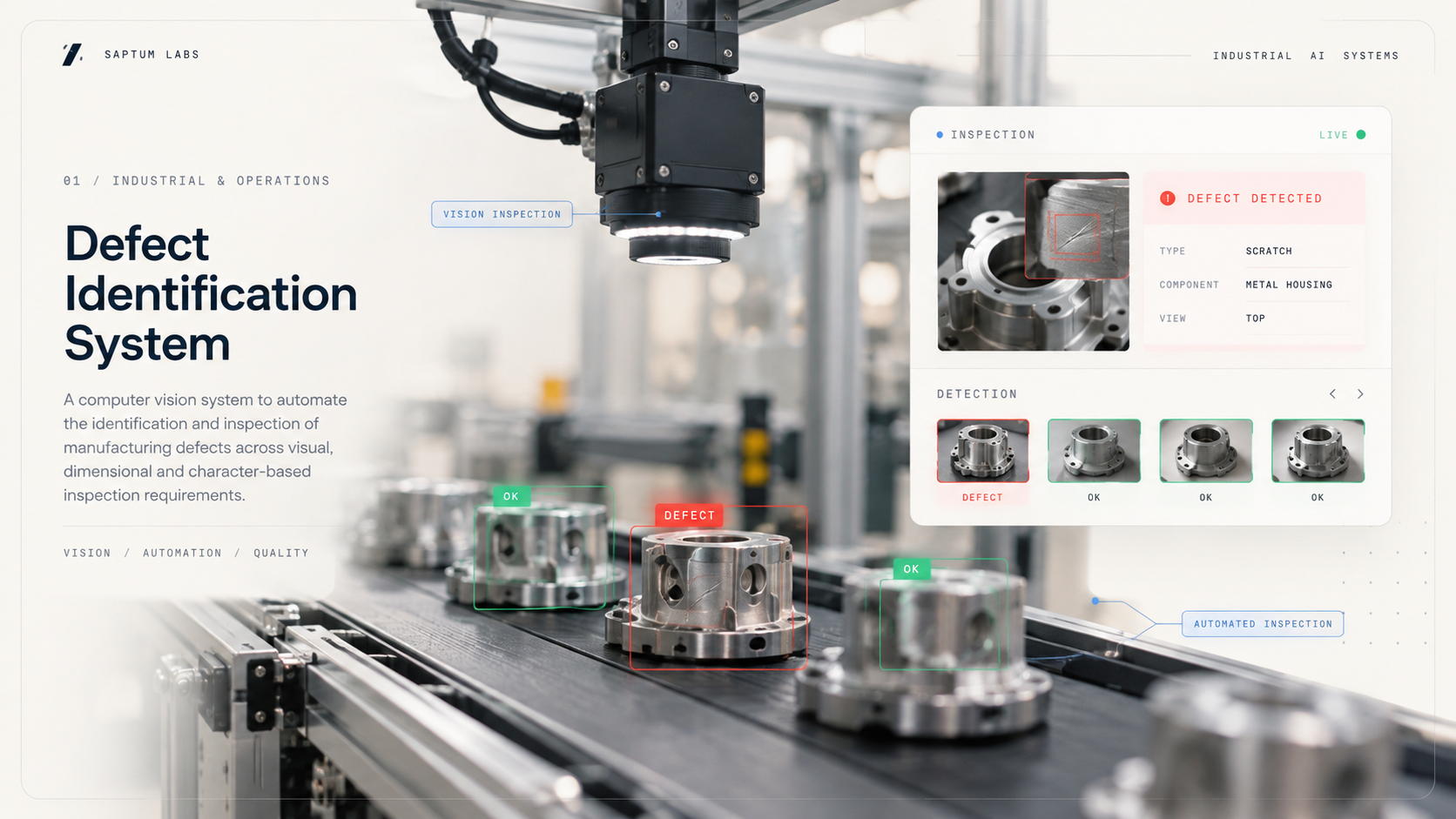
A computer vision system developed for a Singapore-based client to automate the identification and inspection of manufacturing defects across visual, dimensional and character-based inspection requirements.
- Category
- Industrial AI · Computer Vision
- Relationship
- Technology Development Partner
- Client
- Singapore-based client
- Status
- Industrial AI · Delivered
01 / The problem
Many defect types, each needing a different inspection method
Manufacturing inspection can involve surface scratches, fiber dust, spots, cracks, edge damage, surface irregularities, dimensional deviations, potting residue and missing or misaligned characters.
The challenge was not simply detecting whether a defect existed. Different defects required different approaches: visual detection, dimensional measurement, edge analysis and character recognition.
Some requirements involved very small defects and pixel-level measurements, adding challenges around camera calibration, image quality, lighting, data availability and processing latency.
02 / The approach
A computer vision pipeline, not a single model
Saptum combined deep learning with traditional computer vision, choosing the right technique for each defect being inspected.
03 / What we built
Core inspection capabilities
04 / How it works
From image to inspection decision
- 01
Image capture
- 02
Image preprocessing
- 03
Detection / classification
- 04
Measurement
- 05
Defect decision
- 06
Inspection output
05 / Outcome
Engineering impact
- Automated image-based inspection
- Reduced dependence on purely manual visual inspection
- Support for multiple defect categories
- Low-latency edge processing architecture
- Modular approach for adding new defect types
- Foundation for continuous model improvement
- Integration-ready inspection workflow
06 / Saptum's role
Technology Development Partner
- Computer vision development
- Machine learning approach
- Image-processing pipeline
- Inspection logic
- System engineering
- Edge-ready architecture
07 / Technology
AI & vision
Engineering